


Sustainable shipping isn’t something you’d imagine an alternative asset, fintech, and ESG-focused marketing studio would be concerned about.
But hear us out.
Sustainable shipping matters, and impact and ESG-focused investing can support and make shipping more sustainable.
One supports the other, and as we are an ESG-focused marketing studio we are keen to help impact investment firms secure more investors so they can back initiatives, like sustainable shipping.
As Nordea has uncovered, the C02 savings from sustainable investing is 27X more impactful than making lifestyle changes.
Think about that for a moment.
One fund manager can do more on a quiet afternoon of making investments that fund sustainable initiatives than a whole street of households recycling every last thing that can be recycled every week.
Not that you shouldn’t recycle, or use paper straws, or eat meat substitutes; humanity benefits from everyone doing whatever they can. We only have one planet, and no plan B.
But the impact from making the right investments are outsized compared to a million paper straws.
Nordea, an impact and ESG-focused bank are big supporters of sustainable shipping because they know how impactful these investments can be.
That’s why this is a topic that interests us, and why it makes a difference to the planet, our oceans and atmosphere, and the global economy.
Sustainable shipping in action: Reverting to wind to power the future of shipping
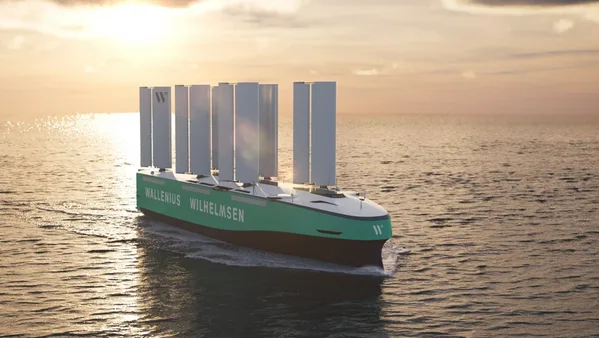
Image from a Nordea sustainable shipping case study: Wallenius Wilhelmsen’s wind-powered RoRo vessel. Photo credit: Wallenius Wilhelmsen.
Why sustainable shipping matters for the environment?
Without shipping, global trade would stop. This isn’t an exaggeration or a narrative device.
Our economy relies on the maritime industry.
Without shipping as we know it:
- Shelves full of food from all over the world in our supermarkets: Empty.
- Those clothes you buy online on a quiet Sunday afternoon: Unavailable.
- That thing you really need on Amazon: That brown box won’t be getting delivered the next day, or the day after, either.
- Energy products ⏤ also essential for the global economy ⏤ a large percentage comes via ships: 17% of natural gas and 36% of petrol.
Our modern, interconnected, global economy relies on shipping and logistics.
Overall, “80% of goods by volume” are transported by ships from one port to another (International Chamber of Shipping).
And yet, shipping and logistics can be pretty bad for the environment. According to the International Maritime Organisation (IMO):
- Shipping emits 1,000 Mt CO2 per year, which is 3% of global CO2 emissions.
- Between 1990 and 2008, shipping emissions increased dramatically, coupled with a surge in seaborne trade.
- Hence why the IMO uses 2008 as its baseline for future projections, with shipping generating 2.76% of global greenhouse gas emissions.
- In 2018, based on pre- and post-Covid projections, the IMO is expecting a further period of emission outputs anywhere between 90-130% of 2008 levels by 2050. Either way, unless significant changes are made, the IMO is expecting the damage the industry is doing to increase rather than decrease.
- Ships emit Sulphur Dioxide (SO2), contributing to air pollution, particularly when a ship is docked in a port.
- Ships in transit emit Nitrogen Oxides (NOx) and particulate matter, further degrading air quality.
- Oil spills, underwater noise, propellers striking whales and dolphins, and the accidental movement of non-native species to new ecosystems are all part of shipping damage to the environment.
- At EU level, maritime transport represents 3 to 4% of the EU’s total CO2 emissions, or over 124 million tonnes of CO2 in 2021.
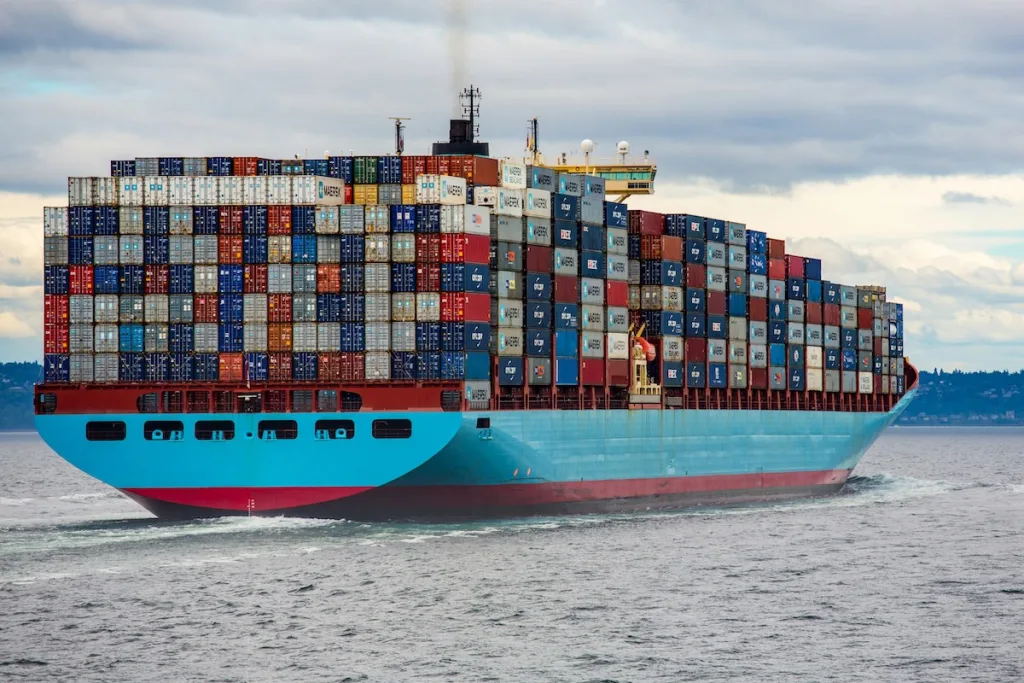
Naturally, the maritime industry is keen to demonstrate that ships are far less polluting than other forms of transport, particularly airplanes.
However, that doesn’t change the fact that the maritime industry is responsible for 3% of global CO2 emissions ⏤ also known as greenhouse gasses ⏤ and this is likely to increase unless significant positive changes are made over the next 5 to 10 years.
Proof of this is during the Covid-19 pandemic, global trade reduced significantly, albeit temporarily, and so did harmful emissions from shipping. According to studies, the reduction was in the 7.4 %–13.8 % range for the worse greenhouse gas offenders: NOx, CO, HC, CO2, and N2O.
What’s essential now is for this to become permanent, not through the collapse of global trade and civilization as we know it, but through steady and sustained investments across the maritime and logistics industries that will produce an ongoing reduction in global greenhouse gas emissions.
Here are 5 ways the shipping industry can achieve this, and how the ESG finance sector can support and help drive these changes.
5 Maritime transport sustainable initiatives
- Decarbonisation
The good news is that the shipping industry has already agreed on a legally-binding Net-Zero framework and target.
In October 2025, the IMO Net-Zero Framework based on IMO’s MEPC83 talks, will be formally adopted.
For all member states, this includes a Global Fuel Standard (GFS) for ships and a global emissions pricing mechanism. It will come legally into force in March 2027, and take effect from 1 January 2028.
The GFS Net-Zero target is calculated using an all-encompassing “well-to-wake approach”, covering:
- Emissions from fuel production;
- Getting fuel to ships;
- Fuel ships use;
- Emissions from the use of that fuel.
Like cars, every ship’s fuel consumption and the emissions from them differ depending on a number of factors, like the age of a vessel, the journey, and conditions on route.
Ships that emit more greenhouse gases will pay for every extra tonne of CO2 equivalent emitted. Ships that are low-emission will be rewarded, and there will even be a secondary market where low-emission vessels can sell their CO2 to underperforming ships.
The EU was ahead of the IMO, thanks to the FuelEU Maritime Regulation, which came into force on 1 January 2025. This covers every ship entering EU and European Economic Area (EEA) waters. Shipping companies, owners, and operators are implementing new carbon emission monitoring technologies, if they’ve not already done so.
- Slow steaming (reduced speed)
Another way for ships to reduce carbon emissions is to reduce speed, known as slow steaming.
Because ships, particularly ones carrying cargo or fuel, are trying to get from one port to another as quickly as possible, they usually travel faster than the speed which is optimal for fuel use and emissions: 10 to 14 knots.
The speed depends on the type of vessel, gross tonnage in water (when loaded), and of course, sea conditions. And yet, if a journey were permitted to take longer, “decreasing a ship’s speed by just 10 per cent can reduce its overall energy use by 20 to 30 per cent”, according to the World Wildlife Fund (WWF).
Not only could that reduce underwater noise pollution and potential animal collisions, but it could keep underperforming ships below the IMO and EU greenhouse emission thresholds.
- Crew safety and training
Transitioning to a greener future is going to require ships crews learning new skills. Safety is a crucial part of this.
New, greener fuels like ammonia, methanol, and hydrogen are more dangerous than traditional fuels, so specialised handling, storage, and emergency response training will be essential.
- Use of green corridors
The investment required for this industry to go green is enormous. So big that it hasn’t been calculated. Numerous parties are involved in the process of greening shipping, but it will take many years, even decades to come to completion.
To accelerate this transition, Green corridors are being developed worldwide which are “designated maritime routes where the decarbonisation of shipping is accelerated through public and private collaboration.”
There are already 6 underway, with a further 44 in development. These green corridors are testing grounds for decarbonisation. Implementing them “will require cooperation across the entire value chain, from fuel producers and port operators to regulators and financial institutions.”
- The challenge of an ageing fleet
Shipping fleets are ageing.
It’s an accumulation of problems that all comes back to money:
- Too many vessels are nearing the end of their serviceable life
- New ships are not being built at the rate of previous decades
- Too many old ships are re-entering service through busy second-hand markets
- And the industry currently has low demolition rates
This means that newer, more fuel-efficient ships aren’t being built at the rate the industry needs, and older ships are still cutting through the world’s oceans, polluting as they go.
As Nordea says: “Significant capital investment is required to build new vessels, retrofit existing ones, and decommission outdated tonnage to meet decarbonisation targets.”
Investor support needed to transform shipping
This great transition to a greener future for shipping starts with the willpower ⏤ which data already shows us does exist ⏤ and needs to be backed-up with investor and government funding.
Let’s look again at the Nordea sustainable shipping case study, as this is a great example of investment in action.
Here is what the shipping and logistics giant ⏤ with 125 ships, 15 trade routes, 66 processing centers, 8 marine terminals, and 1000s of trucks across 6 continents ⏤ Wallenius Wilhelmsen is doing, and how Nordea are helping them achieve a net-zero target by 2040:
Alternative fuels
The transition from fossil fuels to low-carbon alternatives, such as biofuel and methanol, is projected to be the most significant contributor to the company’s emission reduction efforts by 2040.
Technical and operational improvements
Substantial technical and operational improvements to the current fleet will also help drive the decarbonisation effort. These range from engine upgrades and wind-assisted propulsion systems to maximise vessel utilization and speed optimisation.
New vessels
New methanol dual-fuel vessels under order will offer enhanced fuel efficiency and flexibility.
As the Wallenius Wilhelmsen CEO, Lasse Kristoffersen, says: “Transitioning to a fossil-free future is challenging, but essential. Climate change requires new technologies, infrastructure, low-carbon fuels, energy-efficient operations, and partnerships. The cost of achieving net-zero is significant – but insignificant compared to doing nothing.”
Wallenius Wilhelmsen’s Sustainable Financing Framework, with the 2040 Net-zero goal as the #1 target is sustainable financing done right, and at scale:
- It covers both green financing and sustainably-linked financing;
- It can be used in both bond and bank markets (Nordea is far from the only financial backer of this);
- The green use-of proceeds aligns with the EU Taxonomy’s substantial use criteria;
- Emission reduction targets are validated by the Science Based Targets initiative (SBTi);
- It also received a strong second-party show of support from S&P Global Ratings.
Key takeaways: Sustainable shipping and ESG investing
With a collective responsibility for 3% of human greenhouse gas emissions, the shipping industry can play a meaningful role in improving the health of our planet.
Investors can actively contribute to this, through smart impact-based investments, and ESG or infrastructure investment funds, like ITE Management.
For ESG investment firms that want to attract more investors, that’s where a studio like Uncommon can provide support.
Let us help you attract and win the investors you need to achieve your goals and make an impact on the planet.
Would your company benefit from our skills and expertise?
Now more than ever, alternative asset firms need to stand out and get noticed. You need investors to clearly see the advantages of investing in your offering.
You can’t sit out another cycle waiting for investors to notice you. We can help you with that.
Let’s start with us looking at what you’re already doing and your goals: Based on that, we can put together a plan of action.
Sounds interesting? Email us at: admin@fintechcontent.marketing, and we’ll find time for a no obligation 15 minute discovery call.