


Financial CMOs — whether you work for an alternative asset firm, ESG firms, FIs, FinTech Saas, or another financial sector organization — are under pressure to get results.
That’s always been the case, but it feels particularly acute, now more than ever.
This is for a number of reasons:
- The risk of a recession;
- A massive generational transfer of wealth;
- The necessity of digital advertising;
- AI bots eroding trust online;
- Google and AI market-leaders changing the search environment.
We discuss all 5 in this article, and give CMOs a quick, ROI-focused solution for generating results in the short-term.
Give your brand the boost it needs, and use that to leverage long-term brand-building focused growth.
5 factors financial CMOs need to understand in this changing environment
- Recessionary risks
At the start of 2025, everyone knew that Trump would soon be US President.
Markets and investors had factored this in, it was “factored in” as a risk and opportunity.
With that in mind, J.P. Morgan Private Bank analyzed the US and world economy, and stated that, “Our current subjective view is that there is a 20% chance of recession” on 28 January 2025.
Only 6 weeks later, following the madness of “Liberation Day” and a rapidly escalating trade war, Goldman Sachs “raised the odds of a U.S. recession to 45% from 35%, the second time it has increased its forecast in a week.”
The most recent predictions from J.P. Morgan Research, which mirrors what numerous other analysts and investors are saying and thinking:
“The probability of a recession occurring in 2025 is up to 60% — up from 40%.”
The cause is obvious as it is existential and as potentially hard to control or prevent: “Aggressive tariff policy could push the U.S. — and possibly the global economy — into recession this year.”
J.P. Morgan Research went onto show that:
- The latest unwinding of the Liberation Day tariffs reduces the shock to the global trading order, but the remaining universal 10% tariff is still a material threat to growth.
- The 145% tariff on China keeps the probability of a recession at 60%.
- The Fed expects to start easing in September, with further cuts at every meeting thereafter through January 2026 — reaching a 3% policy rate by June 2026.
- The ex-ante (pre-substitution) tax hike amounts to nearly $1 trillion, or 3% of GDP — making it the largest tax increase on U.S. households and businesses since World War II.
However, this isn’t the only factor CMOs need to consider.
Especially for legacy financial institutions, investment funds, brokers and advisors, oh the times they are a changing.

- Generational transformation
Worldwide, a huge wealth transfer is underway.
For banks and asset managers wanting to make greater inroads into the Millennial and Gen Z markets, there’s never been a better or more opportune time.
Both generations are of bankable age, and need access to financial services. Millennials in particular are open to every kind of financial product, from mortgages to retirement accounts.
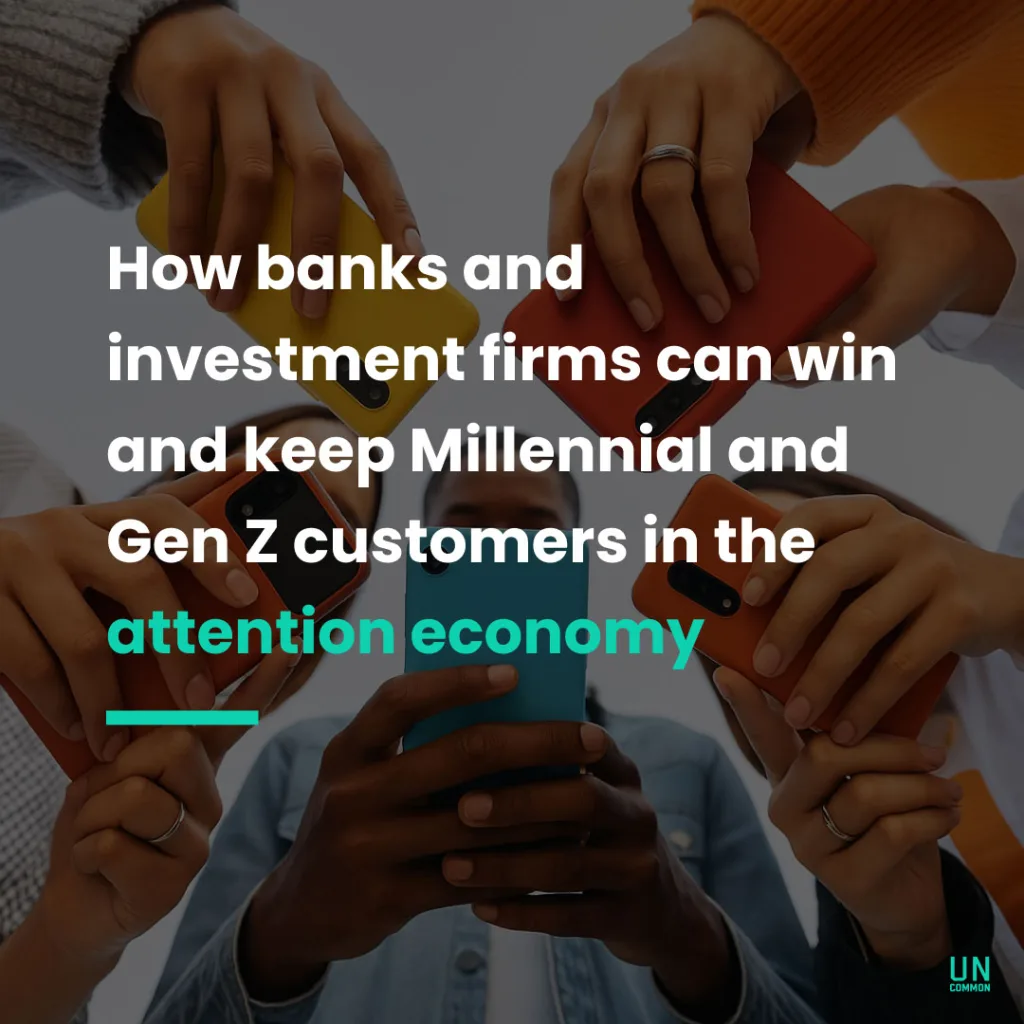
The challenge is, how do banks, asset managers, and financial advisors win and retain Millennial and Gen Z customers?
This is a particularly acute challenge for financial institutions and advisors who are still reliant on Baby Boomers for customers. Their children and grandchildren aren’t going to come to you by default just because of tradition.
You’ve got to work harder to win Millennial and Gen Z customers. Younger and now middle-aged customers operate in “the attention economy”, and that’s what you’ve got to do: capture their attention and keep it.
Doing this won’t be easy. You aren’t marketing to their parents anymore.
You need to take a creative approach.
💡Take a look at our article about how to win and retain Millennial and Gen Z customers.
- Dominance of digital
Over the last 10 years, the ways that banks and FIs have invested marketing and advertising budgets have changed.
According to BAI, “Digital channels now represent nearly 62% of bank marketing budgets, compared to 38% for offline channels. This shift reflects a growing focus on platforms that deliver clear attribution and measurable results.”
According to Vericast’s Lookback Trends that Will Define 2025: Banking Ad Trends report: Financial institutions are narrowing their focus to the channels and tactics that deliver. Social media remains dominant, while display ads have declined. Since TikTok and YouTube have surged in the last two years, mobile-first strategies drive much of the planning.”
Chad Schmidt, vice president and digital advertising specialist at Vested, says that: “Performance marketing is now the focus. The ability to directly attribute spend to customer actions — whether that’s account sign-ups, mortgage inquiries, or engagement metrics — makes digital the dominant choice.”
- Return of the AI Bots
AI bots are a bigger problem than many of us realise.
And this has a direct impact on how brands market themselves online and the metrics they use to measure success.
In November 2024, an article we published about the erosion of online trust showed that 50% of web traffic is AI/bots, according to the 2024 Imperva Bad Bot Report.
Because of this, 59.9% of people are questioning the authenticity of online content more than before.
As a result, people are eager to return to a more pre-digital existence, or at the very least, rely on digital less and experience the real world a lot more.
Since then, Eric Schwartzman, has spent the last 6 months investigating this further, and is currently working on a book on this topic, Invasion of the Bot Farms.
In an article published in Fast Company, Schwartzman shows us how corrupted the world of online popularity, “going viral”, and mass manipulation has become.
AI bots and bot farms are actively being used to manipulate the public, what we think, care about, get angry or upset about, buy, and how we invest.
Using millions of fake accounts, these AI bots can pass the Turing test, which means they can escape detection.
And the big social platforms, like Facebook, Instagram, and even LinkedIn, know that this “coordinated inauthentic behavior” can and does fool their algorithms.
A bot farm is a call-center-like operation consisting of hundreds, if not thousands, of phones and devices, all controlled by one AI-powered computer.
As Schwartzman says: “The bot farm broadcasts coordinated likes, comments, and shares to make it seem as if a lot of people are excited or upset about something like a volatile stock, a global travesty, or celebrity gossip—even though they’re not.”
We can’t ignore the threat of bots, AI, deepfakes, and bot farms.
But we can focus our efforts where it will make a positive impact.
Now more than ever, succeeding with online marketing, content, and brand building means giving your audience, customers, and potential customers the following:
- An easy way to verify that anything online using your name/logo is authentic and genuine
- A reason to trust and keep trusting your brand
- In-person events and high levels of customer service
- Video interviews and more in-depth content.
- Your humanity and authenticity.
💡 Read our article to find out more about AI bots and bot farms.
- AI as Search, Google AI Overviews, AI Mode: What these mean for financial services marketing
There are three overlapping areas CMOs need to understand, and quickly, and all of them involve AI:
- AI as Search: People getting answers from OpenAI’s ChatGPT and other AI tools. Although these aren’t taking as much traffic as people might imagine. But as user adoption increases, that could change.
- However, Google AI Overviews (AOIs) are taking traffic directly from websites, and this directly impacts traffic KPIs that CMOs are measuring.
Now, if those issues weren’t worrying enough, Google is rolling out AI Mode.
AI Mode: “Is Google’s most powerful AI search experience. You can ask anything and get an AI-powered response, with the ability to go deeper through follow-up questions and helpful links to the web. AI Mode expands what AI Overviews can do with more advanced reasoning and ways of interacting.”
“It divides your question into subtopics and searches for each one simultaneously. This way, AI Mode can explore the web to find even more relevant content that matches your question.”
Rise at Seven, an award-winning search-first PR agency for B2C brands has analysed what this means: “Google’s search results are now hyper-personalised — and I mean creepily personal. It’s no longer just about where you’re located. It’s about who you are, what you’ve done, what you’re likely to want, and what you haven’t tried yet.”
“This isn’t a search engine. This is your search engine.
Search has become intent-aware, mood-aware, and even routine-aware.”
- Rethinking what SEO is. It’s now audience, authority, and behaviour-based.
- Investing in audience insight tools – not just keyword research. You need to know your people better than Google does.
- Stop trying to be everything for everyone. Own your niche, and build semantic authority around it.
- Diversifying into TikTok SEO, YouTube intent, and emerging search surfaces. SERP volatility is only increasing.
- Be the signal. In a world of AI-generated answers, you need to be the source it’s quoting.
Where should financial CMOs focus their efforts to generate an ROI quickly?
With all of that in mind, let’s refocus on what matters, both in the short and long term.
As a CMO, you need to get results from marketing activities.
Marketing should be a direct pipeline into the sales funnel.
As a result, you need marketing to generate an ROI.
In the long-term, and especially if you want to navigate a changing search landscape and generational handover, brand building and better storytelling is, in our experience, crucial.
Research from the Ehrenberg-Bass Institute shows that brand building is a marathon, not a sprint.
The value of your brand is an asset. The goal is to maximize the ROI of that asset.
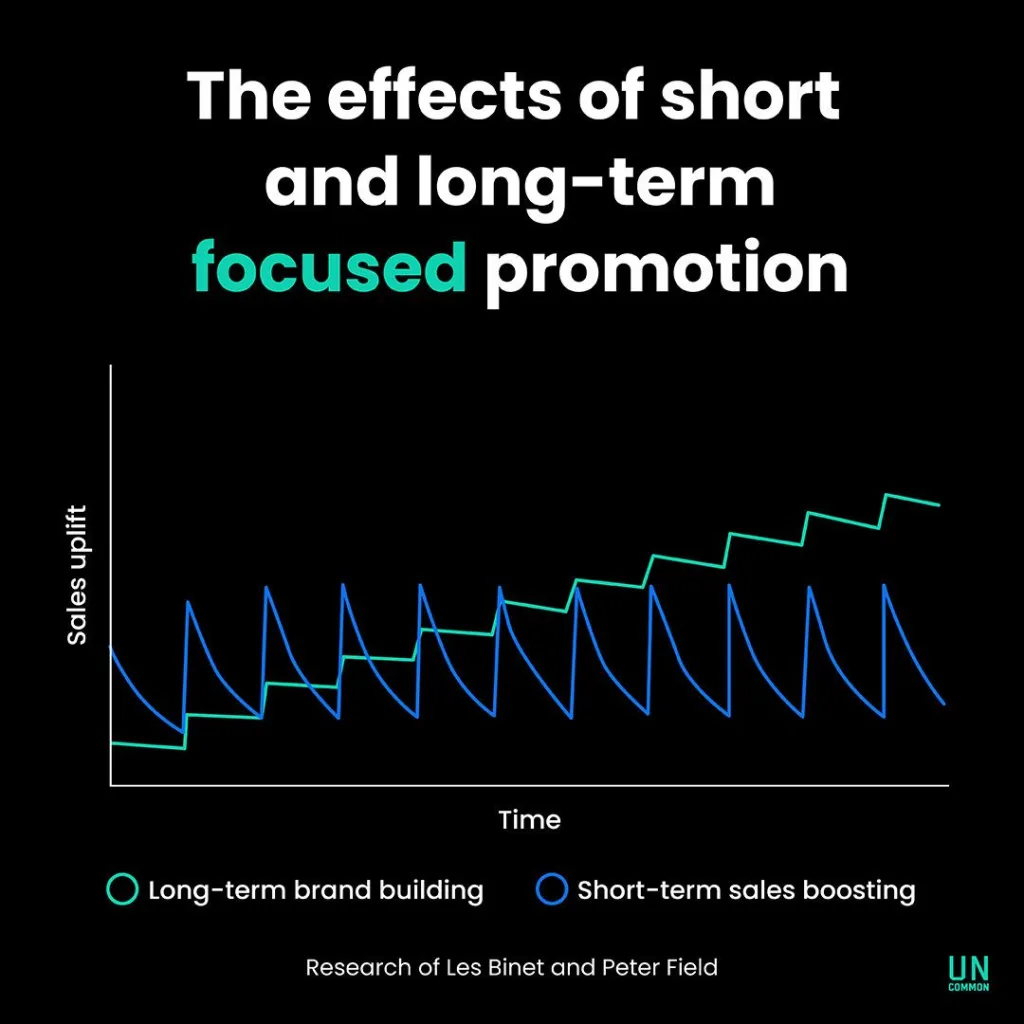
However, because brand building is a long-term investment, you also need something that’s going to generate cashflow in the short term. Once shorter term ROI is secured, it’s easier to make the case for long-term brand building efforts.
💡We have a solution: Account-based marketing (ABM).
It’s always easier to generate revenue from customers who already know and trust you, and are benefiting from your services, than to win new customers.
Offering up-sell opportunities is more effective than spending heavily on acquiring new customers. As numerous studies have shown, it’s 5 – 10X more expensive to win new customers, and existing customers are 67% more likely to spend more with a supplier/partner than source a similar service elsewhere.
Unlike brand building or outbound sales, ABM is quicker and more cost-effective. Data shows it will likely generate an ROI sooner. According to studies, “92% of companies with ABM programs report it drives more ROI than any other marketing tactic.”
You could also target an opt-in database using a newsletter, or hyper-personsalised newsletters offering different services and solutions to a series of segmented databases.
As a short-term measure in times of uncertainty, this is a lever that cost and time-pressured CMOs would be smart to pull.
We can support you every step of the way.
Would your company benefit from our skills and expertise?
Now more than ever, alternative asset firms need to stand out and get noticed. You need investors to clearly see the advantages of investing in your offering.
You can’t sit out another cycle waiting for investors to notice you. We can help you with that.
Let’s start with us looking at what you’re already doing and your goals: Based on that, we can put together a plan of action.
Sounds interesting? Email us at: admin@fintechcontent.marketing, and we’ll find time for a no obligation 15 minute discovery call.