


“For the first time, global warming has exceeded 1.5 °C across an entire year, according to the EU’s climate service.” (BBC).
That summed up the reality of climate change for 2024.
We are on course for the same or worse in 2025.
Businesses and investment decisions play a role, in many cases a significant one, in reducing greenhouse gas emissions and the devastating impact of climate change.
We have a chance — albeit an ever-shrinking window of opportunity — to turn this around.
Businesses can and are making a difference.
Investors, and investing in impact, ESG, and ethics-based firms, do generate positive change, not just positive returns.
As Nordea found, the C02 savings from sustainable investing are 27X more impactful than making lifestyle changes. This is an impressive and impactful stat, and one that lands with their customers.
Ethical investments are better for shareholder value, the planet, people, and good corporate governance.
Numerous studies have also shown that “sustainable investments generate 60% higher returns than traditional, unsustainable investments.”
The point is: Businesses and investors can do more, and benefit their organizations and portfolios at the same time.
In this article, we look at what businesses are doing beyond talking a good game about climate change.
A Planet on the Tipping Edge of Being Liveable
Graph 1: Exceeding 1.5 °C for all of 2024
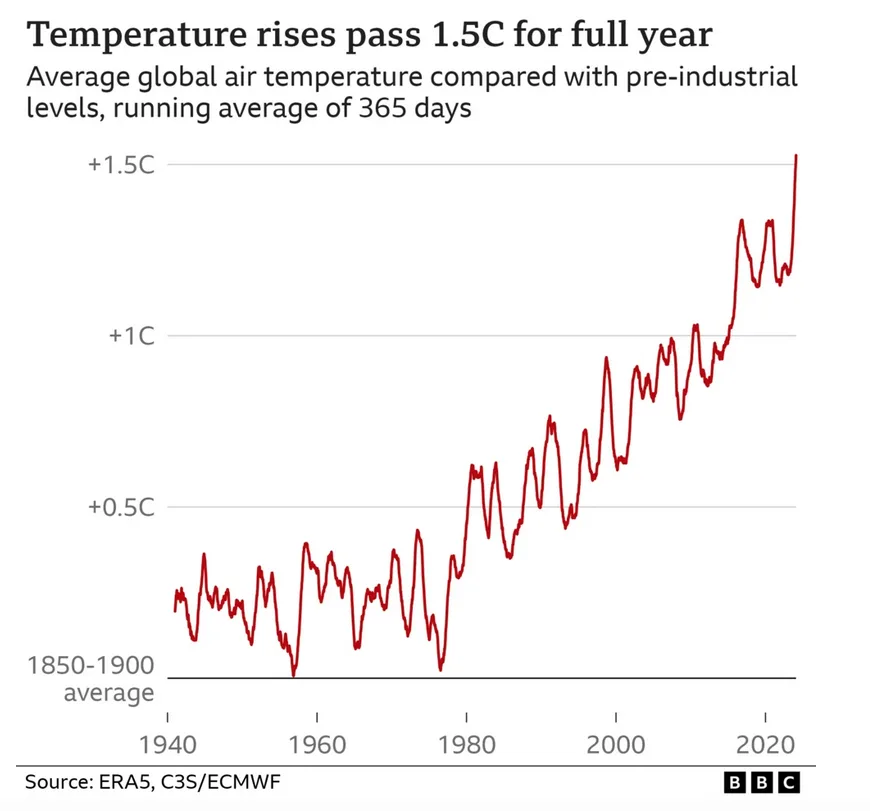
Source: the EU’s Copernicus Climate Change Service.
Marina Silva is taking a second swing at arguably one of the most important government ministries that could impact climate change (in a positive way): Brazil’s environment and climate minister.
Silva assumed control when everything was getting much worse for the vital and delicate Amazon ecosystem.
As the WWF notes: “An estimated 17% of Amazon forests have been converted to other uses and an additional 17% degraded.”
The Amazon is absolutely crucial for the survival of the planet’s climate: “Not just for food, water, wood and medicines, but to help stabilise the climate—150-200 billion tons of carbon is stored in the Amazon rainforest. The trees in the Amazon also release 20 billion tonnes of water into the atmosphere per day, playing a critical role in global and regional carbon and water cycles.”
Under the previous administration, Brazil had all but abandoned any pretext or actual action that would help reverse the devastating impact of climate change, including deforestation of the Amazon rainforest.
“We had deforestation on an ascending curve that was out of control,” Silva told TIME Magazine recently.
Make no mistake, the Amazon is still at a tipping point.
However, TIME Magazine confirms that: “According to the most recent official account released last fall, Amazon deforestation had fallen to the lowest level in a decade after dropping nearly in half from two years prior.”
Silva, Brazil’s president, Inácio Lula da Silva, (known as Lula), and every world leader that still backs fossil fuel reduction targets (Paris, COP28, COP30, etc.) knows that: “Even if we can nullify deforestation, with climate change, if we don’t reduce carbon from fossil fuel emissions, the forest will be destroyed anyway,” she says.
Fortunately, Brazil’s government recently “announced a $2 billion financing program to reforest up to 1 million hectares (about the size of the island of Hawaii) of degraded land.”
Brazil is also contributing to a worldwide fund of $125bn to protect and reforest tropical forests globally.
America, however, is causing problems for the planet.
Silva says, “Things have become more difficult, especially with the decisions of the Trump Administration.”
And this isn’t just for Latin American countries; it’s impacting Europe, too.

Europe vs. America
In Europe, the percentage of companies whose lobbying aligns with the EU’s climate strategies has surged from just 3% in 2019 to 23% in 2025.
At the same time, the percentage of businesses that are “misaligned” with EU climate policy has dropped from 34% to 14%, based on InfluenceMap’s analysis of Europe’s 200 largest businesses.
As noted in The Guardian: “In 2019, when the European Commission announced its Green Deal, only one in four companies were lobbying partly in line with Paris Agreement goals of keeping the planet from heating 1.5C (2.7F), the report found. By 2025, that share had doubled.”
In America, since the re-election of Donald Trump as President, and the resurgence of the right in every branch of government, public and business sentiment has turned against ESG-related initiatives.
Data from an ESG report by Bloomberg Intelligence (BI) shows: “The US may stagnate amid the presidential elections and ESG backlash.”
Hence, “Europe is set to remain the most significant contributor [to ESG investment growth] . . . Small, but expanding markets like Japan, Canada and Australia could also support gains”, according to the BI study.
If you’re a firm in those regions, or you want to pull in new investors, it might be a smart move to focus your marketing efforts on regions and countries that are likely to be more receptive to your messaging.
Europe, in particular, is absorbing America’s demand for ESG finance and action on climate change, so America’s losses are likely to be Europe’s gains. This is making Europe (EU, EEC, and the UK), the new market leader in this area.
As BI’s forecasts show: “Europe is set to remain the largest in ESG assets with over $18 trillion in 2030, preserving its 45% global share and CAGR keeping pace with the 3.5% global rate, dipping from 8% in 2014-22.”
It’s important to understand what business leaders are really doing and saying behind the scenes. Public statements can be too easily greenwashed.
With that in mind, let’s take a look at this crucial topic through the lens of the Milken Global Conference.
What are business leaders saying about climate change behind closed doors?
Between 4 – 7 May 2025, at the Beverly Hilton, Los Angeles, business and political leaders gathered at the 28th annual Milken Global Conference. It’s a great way for people to meet away from Manhattan and meet with industry titans and top policymakers in Beverly Hills.
The Milken Institute was founded by a once-leading financier, Michael Milken, who was sentenced for racketeering, securities fraud, and insider trading in 1990.
Since paying $600 million in fines (and a further $500 million in a related civil suit), his release for good behavior, and a cancer diagnosis, he has turned his attention to philanthropic endeavors. He was pardoned by President Trump in 2020, partly on the urging of their mutual friend, and the federal prosecutor who helped get Milken convicted, Rudy Giuliani.
Milken still has a net worth estimated above $6 billion, and along with sponsors and backers, he’s making as much effort in philanthropy as he did in finance and the “junk bonds” markets of the 1980s.
One of its core activities is supporting climate change initiatives, including redeploying capital, and improving our resilience to climate change. Hence why Milken is one conference where climate change is taken seriously.
Even though it’s not strictly a “climate” conference, business leaders attending are more than likely to be playing an active role in making a positive impact on climate change initiatives.
Justin Worland, reporting for TIME Magazine, has been able to give us a few insights as to what’s being said amongst leaders at this conference.

3 Redefined Climate Change Goals for Businesses and Investors
The good news is that businesses aren’t dropping net-zero or ESG-based targets.
Nili Gilbert, vice chair at Carbon Direct, a company that invests in carbon management, told TIME that: “I’ve had hundreds of conversations since the election. I’ve never spoken with a company that said, ‘You know what? We’re going to let go of our net-zero target.”
The spotlight might have been taken away, but the activity, investments, and resources are still focused on making a positive impact.
Protecting People & Physical Assets
One new area of focus is the physical risk posed by climate change and extreme weather events.
Fires, floods, hurricanes, rising sea levels, and other natural disasters pose a material risk to business operations and the people they employ, not to mention the supply chain, technology, and other vendors.
Climate disclosure rules in Europe are forcing companies to “look at how the physical risks of climate change may affect their operations.”
Businesses in the U.S. and worldwide are starting to assess these risks and take them seriously.
Investment is Accelerating
Trillions of dollars are needed to transform the global economy in a way to make Earth a more sustainable closed-loop environment. What’s good for the environment is good for humanity and, therefore, the economy.
The current American administration is deaf to this reality. But business leaders aren’t, even if the actions of this government are forcing ESG-focused budgets to reduce.
However, as conversations at the Milken conference showed, one consequence of the rise of AI is that “the race to build data centers has created a race to build clean energy.”
Business leaders and investors are also accelerating green energy and infrastructure-related investment decisions because many know, regardless of the Trump administration, that we — as a species — simply can’t wait any longer.
Smarter Financing Solutions
Financial innovation is key to making climate initiatives happen.
Across the conference, there were numerous discussions about different financial solutions that would make this work, including “carbon markets and blended finance, where public or philanthropic dollars are combined with return-oriented investment.”
Worland said this “Includes new vehicles like private credit, an emerging asset class where investors outside of typical banks lend directly to companies.”
Alongside these and numerous other initiatives, it’s brilliant to see the impact of the We Mean Business Fossil to Clean campaign, which is backed by the WWF and “Over 200 companies (representing US$1.5 trillion in annual revenue).”
These companies “have signed an open letter to governments to show their support for this shift from fossil to clean.”
Key Takeaways: What Climate Change Means for Alternative Asset Investing
It’s wonderful to see that despite tariffs, trade wars, and the economic uncertainty of the second Trump era, businesses and investors are still as serious about supporting climate initiatives and investments.
Even if budgets are being redefined, there are new capital inflows going to Europe and other regions, and investor appetites are changing, in many ways for the better.
A recent survey by Stanford Graduate School of Business researchers and the MSCI Sustainability Institute of 47 institutional investors with $250 billion AuM found that the main reason that investors put money into ESG funds is:
“Primarily as a way of reducing volatility and risk in their portfolios — especially tail risk, the probability that a rare but catastrophic event could tank a company’s performance.”
The same survey also found that most investors think that ESG should be changed to cover “governance, climate, and social.”
“More than two-thirds of all respondents put governance factors at the top of the list, with environmental factors coming next and social factors barely registering at all.”
Governance determines how well or not a company is managed, alongside the reputation this generates.
For investors, good governance is “table stakes”, and “If you’re a really bad actor, then it’s sort of over.”
The same goes for the environmental aspect of ESG. Data shows that primary concerns are around reducing a company’s carbon footprint:
“78% rank climate change or carbon emissions as the most important environmental factors they explicitly consider when making investment decisions; most say that they are analyzing the emissions associated with their investments, putting money into renewable energy and transition technologies, and quantifying the possible financial impacts of climate-related risk.”
Can all of this current and future activity take us below pre-industrial temperatures and start to reverse the effects of climate change?
Time, money, and a concentration of human effort worldwide will tell.
Want a Free Tailored Sample & Marketing Analysis?
Now more than ever, alternative asset firms need to stand out and get noticed. You need investors to see the advantages of investing in your offering.
You can’t sit out another cycle waiting for investors to notice you. We can help you with that.
We are offering a free, no-obligation marketing analysis and a bespoke sample of copy.
Sounds interesting? Email us at: admin@fintechcontent.marketing, and we will get started for you.