


You’re aware of all the hype around AI, and you may have even invested in one or more AI startups and scaleups.
Alongside any investments, you might already be using AI tools and software in your firm to do tasks like writing emails and analysing investment opportunities. If you’re already seeing AI in practice on a small scale, then imagine:
- Competing and beating much larger firms with far fewer resources;
- Achieving outsized returns for investors with AI-powered portfolios and investment decisions
- Becoming known for better returns and excellent customer service (because your team can spend more time looking after clients and on strategy instead of analysing data).
- Use both to give your firm the edge, taking you from the startup stage to a market leader in a few short years.
That’s what could happen over the next few years if smaller wealth management and alternative asset startups embrace the AI revolution.
Microsoft ⏤ who are long and deep on AI (owning 49% of OpenAI) ⏤ are predicting that AI will transform wealth management.
Martin Moeller, Head of AI & GenAI for financial services, EMEA, at Microsoft, said: “Generative AI will reshape the competitive landscape.” Moeller told Reuters. “AI will, for example, significantly lower the threshold for market entry for startups, similar to what the digitalization and internet wave did decades ago.”
Moeller predicts that the work of whole departments could soon be done by AI models. He cites Klarna, a Swedish fintech, now using OpenAI and other AI tools to do the work of 700 customer service employees.
UBS CEO Sergio Ermotti recently said: “Banks that have so far been barely active in wealth management could enter the business with the help of AI without having to invest much in customer advisors.”
Moeller is expecting that it won’t be long until “Agentic AI” ⏤ AI agents that can do work unsupervised ⏤ and GenerativeAI tools we already have can construct portfolios and make investment decisions without the need for portfolio managers to interact with customers.
Imagine creating the investment and risk management guidelines, and then letting an AI agent develop and manage the portfolio. AI is already playing a role in investments ⏤ and has done for years ⏤ but Microsoft is banking on an evolution beyond algorithm trading for wealth managers.
AI as investment and fund managers
If your firm trades on stock markets, then you know that automated trading algorithms (known as algo and quantitative trading) have been around a lot longer than OpenAI, DeepSeek, Google’s Gemini, Anthropic Claude, and tons of others that have emerged in the last couple of years.
Algo trading already accounts for around 70% of trades on US exchanges. Even in 2018, a study by the Securities and Exchange Commission noted that “electronic trading and algorithmic trading are both widespread and integral to the operation of our capital markets.”
In 2024, the IMF Global Financial Stability Report looked at where algo and AI trading could take the markets and investors in the next few years.
AI-based patents included in new algorithmic trading models are accelerating (see graph below), “suggesting a wave of innovation is coming in this area.”
The IMF notes that this will “further AI’s ability to quickly rebalance investment portfolios, which will in turn lead to higher trading volumes.”
We are already seeing this in the exchange-traded fund market (ETFs).
Traditional ETFs only change investment assets once a year. But a new generation of AI-driven ETFs “Shows a significantly higher turnover compared to other ETFs. AI-driven ETFs do so about once a month.”
However, at present, various AI-powered ETFs are achieving mixed and often trailing results compared to the S&P500.
The risk, as we’ve seen during market turmoil in March 2020, and several “flash crash” episodes (especially May 2010), is that AIs can be too quick to buy and sell. During times of market stress, AI bots can make that stress worse by reacting much faster than humans.
The IMF recommends: “A close monitoring and oversight of this changing market lays the foundation for an opportune and balanced regulatory response that may allow financial sector participants to benefit from AI while mitigating its risks.”
Increased use of AI in algorithm and high-frequency trading
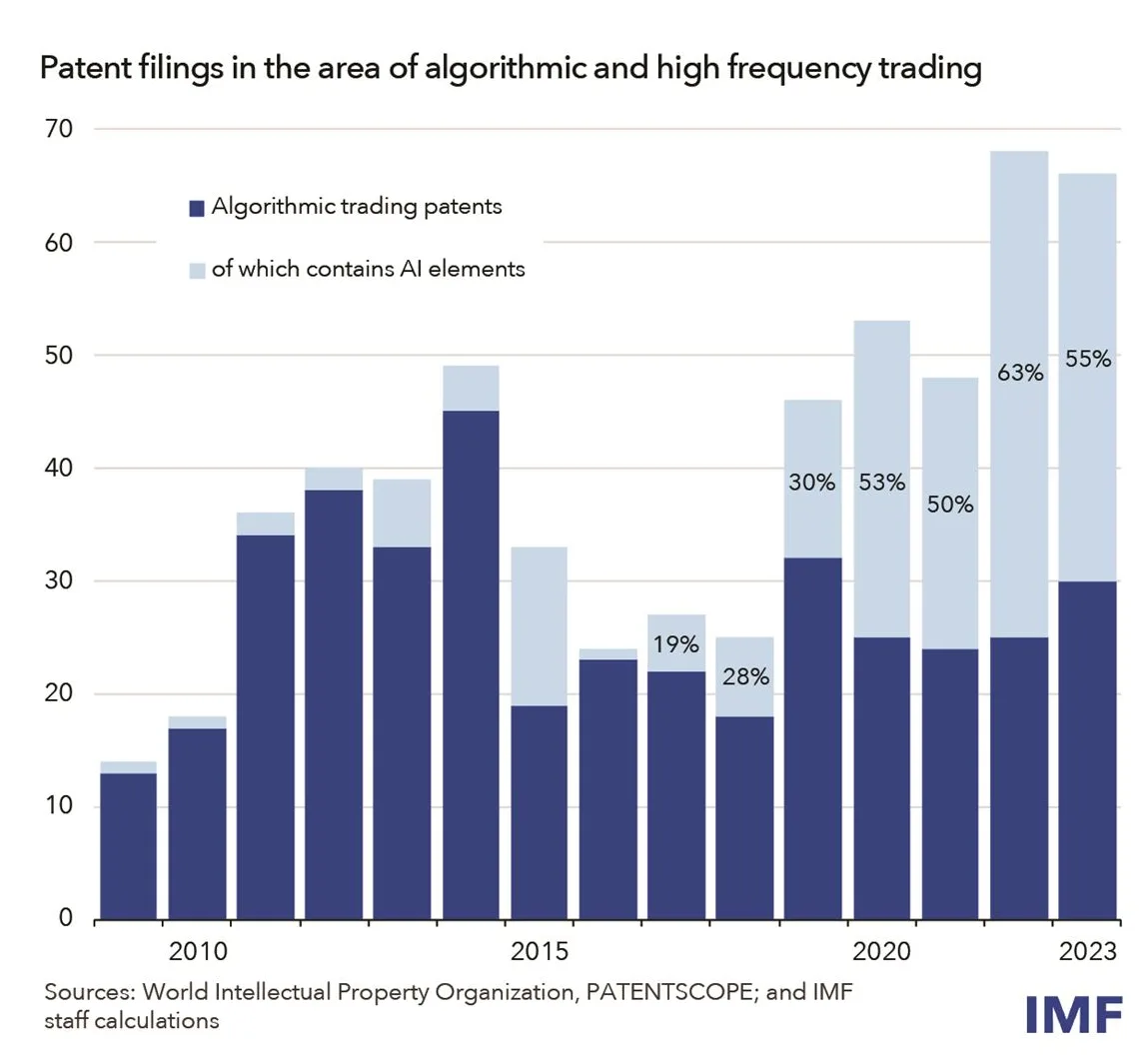
As Generative AI and Large Language Models (LLMs) have evolved, the percentage of patents for new algo trading tools that include AI has rapidly increased, currently at 55% in 2023 (IMF).
AI Could Be The $15.7 trillion global game changer
AIs as investment managers are just one example of the use case for AI tools and software. There are hundreds of others, which is why PwC is calling AI the “$15.7 trillion game changer.”
Data shows PWC is predicting that AI could: “Contribute up to $15.7 trillion to the global economy in 2030, more than the current output of China and India combined.”
This tremendous opportunity for growth is one of the many reasons investors are so excited about AI. It’s one of the reasons OpenAI is currently worth $157 billion.
In recent years, investors, tech and corporate giants, universities, and governments have poured $1 trillion into AI startups, scaleups, hardware makers, and utilities to keep massive data centers operational for dozens of new AI models.
The big question is: Will all of these AI investments be worth it?
Several fund managers at Goldman Sachs Asset Management gave their opinion: “There could be a pause [in massive AI investments] in the near term, obviously, and that’s going to dictate the shorter-term direction of markets. But I think we’re both confident over any medium- to long-term horizon that AI remains one of the biggest trends we’ve seen in our history.”
PwC: The $15.7 trillion opportunity
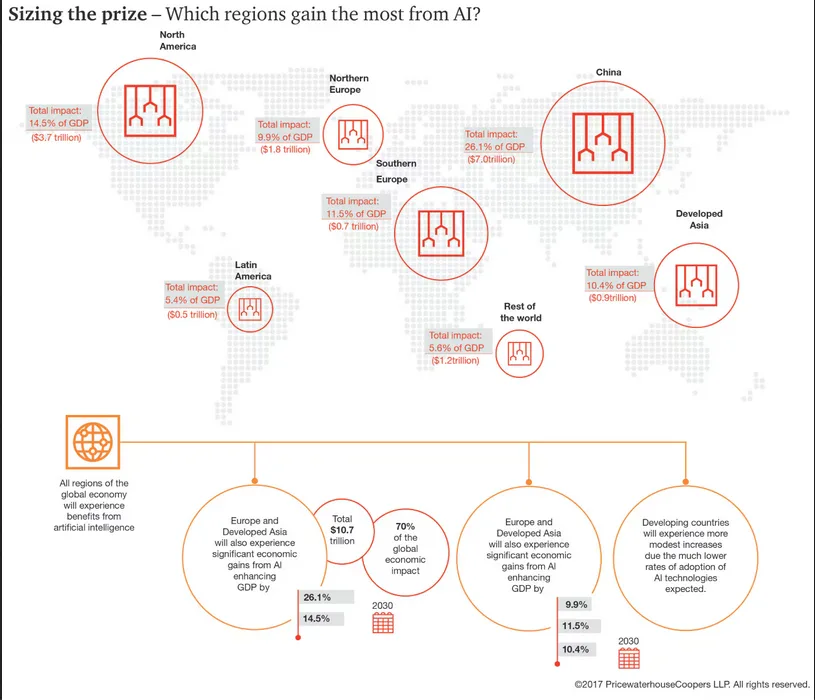
PwC predicts which regions will experience the most gains from AI, with North America potentially gaining 14.5% of GDP, China 26.1%, and Northern Europe gaining 9.9% of GDP.
Could Agentic AI unlock unprecedented growth for wealth managers?
Yes, especially if we are looking at a mid- to long-term horizon. If we are only looking at today, the transformative power of AI for wealth managers isn’t quite there yet.
If it were, AI-driven ETFs would already consistently outperform the markets. Algo and quant trading is a structural part of how markets operate. But, taking that further by introducing AI into the technical mix isn’t moving the needle as much as people hope, at the moment.
Time is the key. Looking at AI patent filings for the financial sector, and Microsoft’s support of Agentic AI, this moment of transformation isn’t that far away.
The AI future for wealth management firms
Microsoft, UBS, PwC, the IMF, and ourselves are confident that AI represents a big slice of the future for wealth managers.
With time, AIs could construct investment portfolios, rebalance them faster than any human, and absorb vast amounts of trading signals and reports at speed and scale.
Getting into this opportunity now, through smart brand positioning and marketing, will give your firm an important edge when those opportunities are a reality.
Do you have a marketing or branding problem that needs solving?
Want to put your value proposition across more clearly?
Get in touch. We can help you.
Take a closer look at our case studies.
We have partnered with Mastercard to create an in-depth, research-backed report about BIN number lookup providers, and with The Peachtree Group to communicate how EB5 visa investment works in the context of hospitality retail developments.